
On 21 April, ESA Phi-Lab NL held its first Expert Session, a new format designed to examine early-stage ideas through focused technical discussion. The session centred on the Dunedain Transients project, which explores the use of high-speed optical measurements to detect and characterise resident space objects (RSOs). RSOs refer to human-made objects in Earth orbit.
Rather than presenting polished results, the project was discussed over the course of a full day with input from specialists across academia, the European Space Agency, the European Union Agency for the Space Programme, and the Dutch space sector.
The core technical discussion revolved around three linked challenges. First, how to detect and extract useful information from RSOs that are too small or too distant to resolve with conventional imaging. The project’s approach of measuring brief dips in starlight as objects pass in front of stars offers a way around classical resolution limits by shifting the problem into the time domain. This raised immediate questions about sampling speed, signal-to-noise limits, atmospheric effects, and the feasibility of reconstructing object properties from millisecond-scale light curves. The group examined where this method could outperform traditional reflected-light observations, and where it would struggle.
Second, the session addressed orbit determination and propagation. Accurate prediction of when and where an occultation occurs depends on knowing RSO trajectories with high precision. Participants debated whether current limitations stem more from measurement accuracy or from the underlying orbital models. The discussion highlighted the variability and uncertainty in publicly available orbit data, and the difficulty of quantifying that uncertainty in practice. A key point was that precise timing of occultation events could provide high-quality angular constraints, but their value depends on how often such measurements can be obtained and how quickly their benefit decays.
The third topic was the detection of very small RSOs, down to millimeter scale. This remains a major gap in current tracking capabilities. The group examined whether optical methods, either through occultations or other approaches, could realistically contribute at this scale. The conclusion was cautious. While the physics does not rule it out, the practical challenges are severe, including low signal levels, confusion with natural phenomena, and the need for dense spatial coverage. Still, the discussion identified potential niche cases where the method could add value, especially if combined with other sensing techniques.
Several cross-cutting themes emerged. One was the trade-off between targeted and blind observations: predicting events increases efficiency but depends on imperfect orbit data, while blind searches demand extreme data rates and wide coverage. Another was the importance of system design, including telescope size, detector speed, and network configuration. The idea of deploying multiple synchronised sensors to capture the same event from different locations was discussed as a way to extract additional information, such as object velocity or shape. At the same time, participants stressed that the practical value of such measurements must be clearly defined, especially in comparison with existing methods.
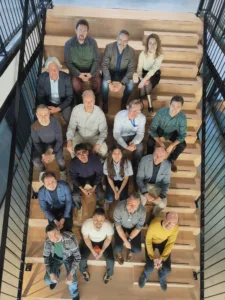
The session also grounded the discussion in operational needs. Representatives connected to public space activities emphasised the demand for better uncertainty characterisation, more reliable data for conjunction analysis, and improved understanding of the debris environment. The project was therefore evaluated not only on technical novelty, but on whether it could contribute meaningfully to these needs. This led to a sharper view of possible use cases, as well as a clearer sense of where further development is required.
Overall, the session achieved its purpose. It subjected the project to detailed technical questioning, clarified its strengths and limitations, and identified concrete directions for improvement. It also demonstrated that ESA Phi-Lab NL can bridge early-stage innovation with high-level technical and institutional input. The result was not a final answer, but a more precise understanding of the problem, and of what it will take to solve it.