
This April, Phi-Lab Netherlands visited Phi-Lab Spain at the Catalonia Institute of Space Sciences (IEEC) in Barcelona, strengthening collaboration within ESA’s Phi-LabNET.The visit supported one of Phi-Lab NL’s ongoing projects, Dunedain Transients, and marked a concrete step toward shared technical development across the network.
The collaboration began months earlier at the European Planetary Science Conference in Helsinki in 2025. There, Phi-Lab NL’s scientific coordinator met researchers from the Montsec Observatory in Catalonia. The team at Montsec is actively involved in monitoring satellites, which prompted a simple question: could they host additional instruments exploring new ways to observe the same objects? That question aligned directly with the goals of Dunedain Transients, a project developing novel optical methods to detect and study artificial satellites and orbital debris. A follow-up meeting between the Dunedain team and Montsec confirmed the mutual benefit of working together.
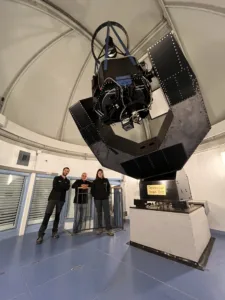
The Montsec Observatory is the leading facility for astronomy and space science research in Catalonia and is operated by IEEC. IEEC also runs ESA Phi-Lab Spain, making the collaboration a natural fit within the broader Phi-LabNET framework. What began as a technical discussion quickly became an opportunity to connect two national Phi-Lab initiatives through a shared scientific objective.
The visit took place in April. After coordination with Phi-Lab Spain, the Dutch team travelled to Barcelona for initial meetings before continuing to the Montsec mountain range. The observatory sits at an altitude of 1,570 meters, offering dark skies and stable observing conditions. The local team hosted the visit and supported the installation effort.
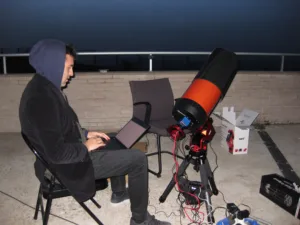
Over the course of a day and a half, the Dunedain equipment was installed and made operational. The work included a full installation day on-site and coordination between both teams to integrate the system. The telescope is now active and collecting data.
This collaboration shows how Phi-LabNET can move beyond coordination into practical, technical cooperation. By combining infrastructure, expertise, and shared goals, the network can accelerate the development of new capabilities in space observation.